
In enterprise software development, the scary part is not the first launch. It is what happens after. More users join. More data flows in. One small bug becomes a late-night incident. That is why many leaders now look for a Certified Indigenous Business team that can build with security and scale in mind, not as an afterthought.
This blog is a practical guide. It shows how strong teams plan enterprise custom software development so it stays stable at 10 users, and still works at 10,000. We will talk about architecture, databases, DevOps, testing, monitoring, and security controls. No fluff. Just what actually holds up when real money and real operations depend on the system.
You will also see how delivery discipline matters. Clear requirements. Clean ownership. Strong documentation. And a culture where security is everyone’s job, not only the security team’s job.
TL;DR
- Certified Indigenous Business teams win when they build security and scalability into the first blueprint.
- Enterprise application development becomes easier to maintain when architecture is modular, and integrations are planned early.
- Enterprise custom software development stays stable when DevOps, testing, and monitoring are treated like core features.
Key Points
- This guide explains Enterprise app development in plain steps, from discovery to support.
- You will learn how Certified Indigenous Business teams reduce risk with security-by-design and strong testing.
- You will see what makes enterprise custom software development scalable, like load balancing, caching, and observability.
What is Software Scalability?
In enterprise application development, scalability means one simple thing. Your software keeps working when load goes up. Loads can be more users, more orders, more API calls, or even more files being uploaded at the same time. If the system slows down, times out, or crashes during peak hours, it is not scalable. It is just “working for now.”
In Enterprise Software Development, scalability is not only about traffic spikes. It is also about growth that looks quiet. More branches. More staff accounts. More reports. More integrations. A Certified Indigenous Business team treats these as real-scale events, not “future problems.” Many Certified aboriginal Business teams also plan for scale with audits and traceability, because enterprise work often needs clear logs and repeatable processes.
Scalability has two sides. First is performance, like response time and throughput. Second is resilience, meaning the system stays up even when something fails. A server can go down. A payment gateway can return errors. A queue can get stuck. Good Enterprise-level software development designs for these failures, so one bad piece does not bring down the whole platform.
Here is a quick way to spot weak scalability in Custom enterprise software development. If every feature depends on one database table or one API, you will hit a ceiling fast. If scaling means “upgrade the biggest server,” costs will climb, and failures will hurt more. A stronger approach is designing parts that can scale independently, with clear limits and clean monitoring.
How Certified Indigenous Business Teams Plan Enterprise Software Development For Scale
In Enterprise software application development, scalability is not one big switch you turn on. It is a set of small design choices that stack up. A solid Certified Indigenous Business team makes these choices early because changing them later is painful. The same is true for many Certified Aboriginal Business teams doing enterprise work. They plan for audits, uptime, and predictable releases from day one.
Below are the building blocks that keep enterprise custom software development stable as usage grows.
1. Start With Modularity, Not “One Big App”
In Custom enterprise application development, modular design means each part has a clear job. Orders stay in one module. Users and roles stay in another. Billing stays separate. When you do this, one slow feature does not slow the whole system. It also makes releases safer, because you can ship changes in small pieces.
2. Use Microservices Only When The System Needs It
Microservices can help Enterprise Software Development scale, but only if your boundaries are clean. A Certified Indigenous Business team usually starts with a modular monolith first, then splits into services when there is a real reason. Real reasons are different scaling needs, different release cycles, or a module that needs stronger isolation for security.
3. Leverage Cloud Architecture With Clear Limits
Cloud helps, but it does not fix weak design. In Enterprise software system development, cloud architecture works best when you set limits and plan capacity. That means auto-scaling rules, rate limits on APIs, and queues for heavy background work. A Certified Aboriginal Business team will also push for clean environments, staging, production, and proper access control, so cloud does not become a security gap.
4. Build Resilience
Resilience means the system stays usable even when something breaks. Payment gateway fails. One service times out. A queue backs up. In Custom software development for enterprise organizations, resilient systems use timeouts, retries with limits, circuit breakers, and fallbacks. It is like having a spare route when the main road is blocked.
5. Treat Security And Compliance As Part Of Scale
More users mean more attack surface. In Corporate software development, scaling without security is a trap. A Certified Indigenous Business team bakes in security-by-design, role-based access, encryption, and logging. Many Certified aboriginal Business teams also document controls clearly, because enterprise clients often need audit trails.
Scalable Architecture Patterns Used By Certified Indigenous Businesses
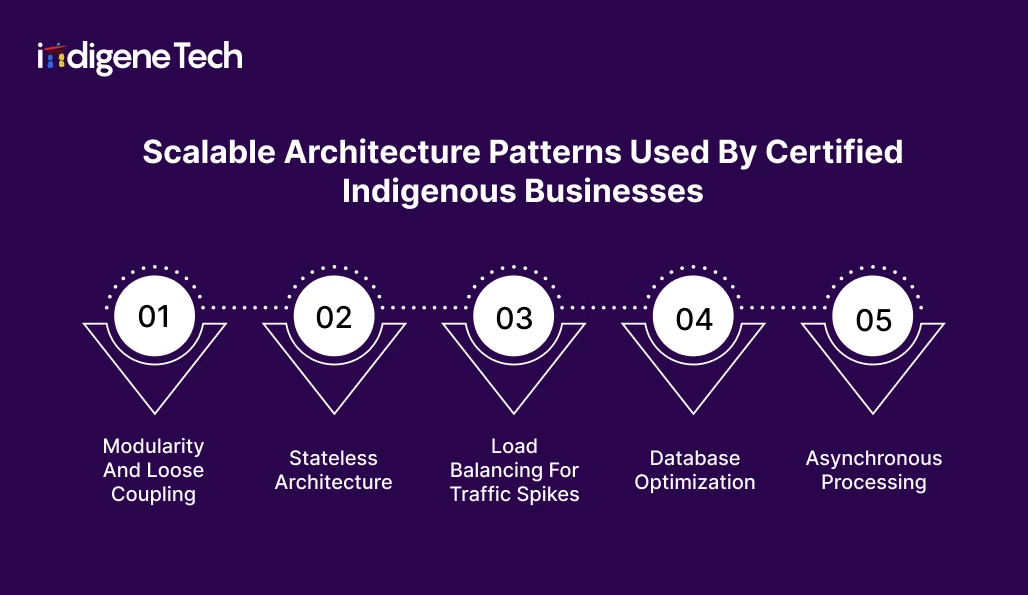
In Enterprise Software Development, architecture is your ceiling. If the base is weak, every new feature feels heavier. A Certified Indigenous Business team focuses on patterns that scale without drama. The goal is simple. Add load, add features, add integrations, and the system should still feel steady. This is the heart of enterprise custom software development.
Many Certified Aboriginal Business teams also work with enterprise clients where stability matters more than flashy releases. So the architecture choices are practical. They reduce downtime risk, and they make support easier after launch.
1. Modularity And Loose Coupling
Loose coupling means parts do not depend tightly on each other. Orders should not break because reporting has a bug. Payments should not block logins. In Enterprise software product development, this makes releases safer and scaling easier, because you can scale one module without scaling everything.
2. Stateless Architecture
Stateless services do not “remember” a user session inside the server. That data sits in shared stores like databases or caches. In Enterprise software system development, stateless design makes scaling easier because you can add more servers behind a load balancer without weird session issues.
3. Load Balancing For Traffic Spikes
Load balancing spreads traffic across servers. It sounds basic, but many systems still fail here. A Certified Indigenous Business team sets up health checks, routing rules, and safe failover. This keeps Corporate software development stable during spikes, like end-of-month reporting or promo campaigns.
4. Database Optimization
Databases are often the first bottleneck. In enterprise custom software development, teams plan indexes, query limits, and read-write patterns early. They also decide what data must be “live” and what can be delayed. This avoids a slow system where every screen waits for one heavy query.
5. Asynchronous Processing
Not every task needs to run in the user’s face. Reports, file processing, notifications, and sync jobs can run in the background. In Software development for enterprises, async processing improves speed and reduces timeout failures. It also makes the system feel faster, even when load is high.
Security By Design In Enterprise Software Development
In Enterprise Software Development, security is not a feature you add at the end. It is a habit you build into every layer. If you bolt it on later, you create gaps. Gaps become incidents. A Certified Indigenous Business team treats security like part of the architecture, the same way they treat performance. Many Certified Aboriginal Business teams also follow this approach because enterprise clients ask for proof, audits, and clear controls.
Security-by-design in enterprise custom software development starts with one question. What can go wrong? Then you design to reduce that risk. Not perfectly. Just consistently.
1. Secure Coding Practices
Secure coding means developers avoid risky patterns by default. They validate inputs. They handle errors safely. They do not leak internal details in logs or messages. In Enterprise-grade custom software development, code reviews include security checks, not only “does it work.”
2. Access Control And Authentication
Enterprise systems have roles, approvals, and sensitive data. In Enterprise Software Development, access control needs to be strict and boring. Role-based access (RBAC) should be clear. Privileges should be the least necessary. Admin actions should be logged. A Certified Indigenous team will also plan for MFA, session expiry, and safe token handling as part of the baseline.
3. Validation, Session Management, And Input Controls
Most attacks come through inputs. Forms, APIs, file uploads, query strings. In Custom software development for enterprise organizations, validation is not optional. Session management matters too. Short-lived sessions, secure cookies, and token rotation reduce damage if credentials leak. A Certified Aboriginal Business team will often include these controls in documentation so audits are easier.
4. Data Encryption
Encryption has two sides. Data in transit and data at rest. In Software development for enterprises, this means TLS everywhere and encryption for stored sensitive fields like PII, financial records, or health-related data. Key management matters here. If keys are sloppy, encryption becomes a checkbox.
5. Security Testing And Regular Penetration Testing
Testing is how you catch issues before attackers do. In Enterprise software application development, security testing includes SAST, dependency scanning, and secrets scanning. Penetration testing is useful too, especially before major releases or compliance reviews. A Certified Indigenous team treats findings like work items, not like shame.
DevOps And Automation In Enterprise Software Development
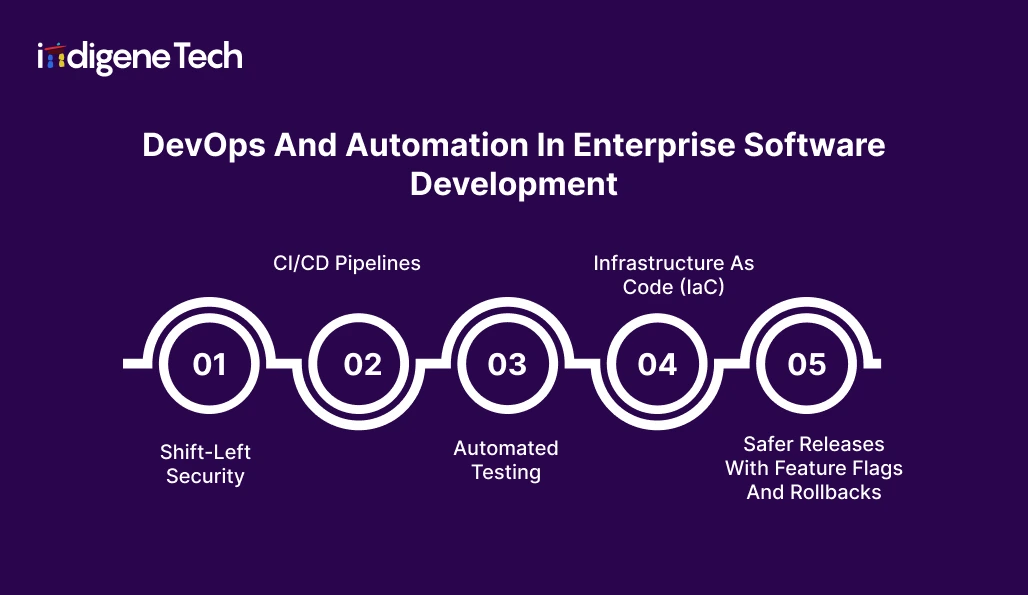
In Software development for enterprises, releases are not one-time events. They are a cycle. New features, fixes, patches, compliance updates, and integration changes keep coming. Without DevOps, teams ship slowly and break things more often. A Certified Indigenous Business team uses DevOps to make releases boring, in a good way. Many companies also follow this route because enterprise clients want predictable delivery and clean audit trails.
DevOps matters even more in enterprise custom software development because every customer environment is different. One client has a strict network. Another needs extra approvals. Automation helps you handle that complexity without turning every release into a manual checklist.
1. Shift-Left Security
Shift-left means security starts early. Not after QA. In Enterprise Software Development, this includes threat modeling during design, security checks in code review, and automated scans in CI. A Certified Indigenous Business team does this so security becomes part of daily work, not a special event before launch.
2. CI/CD Pipelines
CI/CD pipelines automate build, test, and deployment steps. In Enterprise app development, pipelines reduce human error. They also speed up feedback. A failing test is seen in minutes, not after a week. CI/CD is also how you enforce standards, like linting, test coverage, and dependency rules.
3. Automated Testing
Automation is not only for deployments. It is also for tests. Unit tests, integration tests, and API tests catch issues early. In Corporate software development, automated tests protect core workflows like login, payments, approvals, and order placement. A Certified Aboriginal Business team will often insist on “must-pass” test suites for releases because it reduces production incidents.
4. Infrastructure As Code (IaC)
IaC means your infrastructure setup is written as code. Not as manual clicks. In Software development for enterprises, this gives consistency across environments. Dev, staging, production. It also makes rollback easier. For enterprise custom software development, IaC helps when you need to recreate an environment quickly during incidents.
5. Safer Releases With Feature Flags And Rollbacks
Enterprise systems cannot afford long downtime. A Certified Indigenous Business team plans safe rollout methods, like feature flags, canary releases, and quick rollback steps. In Enterprise-level software development, this keeps risk low while still shipping fast.
Monitoring And Observability In Enterprise Software Development
In Enterprise Software Development, the system does not fail politely. It fails at peak time. During payroll runs, month-end reports, or when everyone logs in at 9 a.m. That is why monitoring is not optional. A Certified Indigenous Business team builds observability so you can see problems early, fix them fast, and explain what happened later. Many teams also push for this because enterprise clients ask for incident logs, root-cause reports, and proof of controls.
In enterprise custom software development, observability is like CCTV for your platform. Not for spying. For safety, it tells you where the issue started, how far it spread, and what to change so it does not repeat.
1. Real-Time Monitoring
Real-time monitoring tracks the basics. CPU, memory, latency, error rates, uptime. In Enterprise-grade custom software development, these are your early warning signs. A sudden error spike can show a broken release or a vendor outage. You want alerts before customers raise tickets.
2. Logging That Helps, Not Logging That Floods
Logs should answer questions fast. What failed. For which user? Which service? Which request id? In enterprise custom software development, structured logging makes debugging much easier. A Certified Indigenous Business team also avoids logging secrets, tokens, and personal data, because logs can become a security leak.
3. Tracing
When you have multiple services, one user action can touch five systems. Tracing shows the full path. In Enterprise-grade custom software development, tracing reduces “guess debugging.” You can see where time is spent, where a call fails, and which dependency slowed down.
4. Monitoring And Alerting
Alerts must be meaningful. Too many alerts create noise, and people ignore them. In enterprise custom software development, teams set alert thresholds based on business workflows. Example: “payment failures above X%” is more important than “CPU is high for 2 minutes.”
5. Automated Scaling For Workloads
Auto-scaling helps when traffic jumps. But it works only when your app is designed for it. In Custom software development for enterprise organizations, stateless services, load balancing, and safe database limits matter. A Certified Aboriginal Business team will also define scaling rules clearly, so cost does not explode silently.
Integrations That Scale Enterprise Software Development
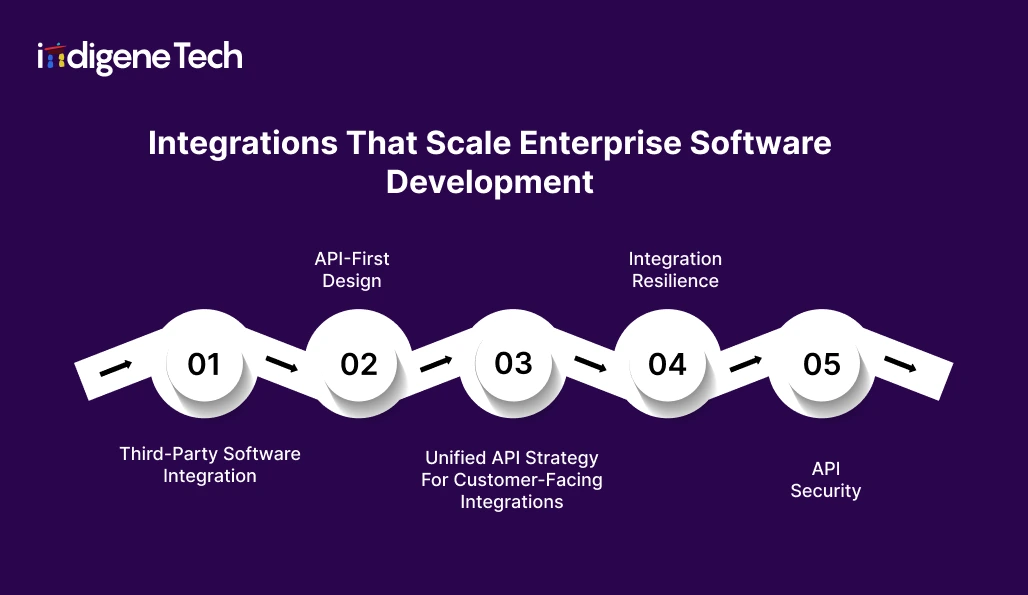
In Enterprise Software Development, integrations are not “extra.” They are the system. Payments, CRMs, ERPs, identity providers, shipping tools, analytics, and internal databases all need to talk to each other. This is where many projects crack. The UI looks fine, but the data flow breaks under load. A Certified Indigenous Business team plans integrations like core features, not like quick add-ons. Many teams do the same because enterprise clients hate surprises after go-live.
In enterprise custom software development, the goal is simple. Integrations should be reliable, observable, and easy to update when APIs change.
1. Third-Party Software Integration
Every integration needs a plan for failures. What happens when the vendor API is down? What happens when rate limits hit? What happens when payload fields change? In enterprise custom software development, teams define retries with limits, queue strategies, and “safe fallback” rules so the user flow does not collapse.
2. API-First Design
API-first means you design the API contract before building the UI around it. In Enterprise platform development, this reduces rework because front-end, back-end, and integration teams align early. It also improves versioning. When you change an API, you do it safely without breaking customers.
3. Unified API Strategy For Customer-Facing Integrations
Many enterprise platforms need to connect with many customer systems. In Enterprise Software Development, a unified API strategy can simplify this. It standardizes data mapping, authentication handling, error logging, and retries across integrations. A Certified Indigenous Business team uses this approach to reduce integration chaos and speed up onboarding new customers.
4. Integration Resilience
Resilience is not only for your own services. It is for integrations too. In enterprise custom software development, teams use queues, dead-letter handling, idempotency keys, and replay tools. This prevents duplicate orders and partial sync issues that create a real business mess.
5. API Security
Integrations often carry sensitive data. In Enterprise platform development, API security includes auth checks, least-privilege access, token rotation, rate limiting, and audit logging. A Certified Aboriginal Business team will also document who has access and why, because enterprise audits ask these questions.
Operational Readiness In Enterprise Software Development
In Enterprise Software Development, “it works on staging” is not enough. Real operations are messy. People forget passwords. Vendors go down. A release breaks on one screen only on one old device. This is why a Certified Indigenous Business team prepares for day-two operations, not only for launch day. Many teams also focus on this because enterprise clients want uptime, quick recovery, and clear incident ownership.
Operational readiness is what makes enterprise custom software development feel safe to run. It reduces panic. It reduces downtime. It also reduces the blame game, because processes are already defined.
1. Version Control And Patch Management
Enterprise systems rely on code, libraries, containers, and cloud services. Updates are constant. In Enterprise platform development, patch management is a routine, not a once-a-year event. A Certified Indigenous Business team sets a cadence for security patches, dependency upgrades, and infrastructure updates, with testing gates so fixes do not create new problems.
2. Incident Response Planning
Incidents will happen. The difference is how you respond. In enterprise custom software development, incident response planning includes on-call rules, escalation paths, communication templates, and “who owns what” during a failure. A Certified Aboriginal Business team will also define how to log incidents and run post-incident reviews, because enterprises often ask for these reports.
3. Disaster Recovery Planning
Disaster recovery is not only for disasters like floods or major outages. It also covers common failures, like corrupted data, accidental deletes, or a bad deployment. In Enterprise software product development, disaster recovery planning includes backups, restore drills, failover strategy, and recovery time targets. The keyword is drills. You do not want to test recovery for the first time during a real outage.
4. Access Reviews And Operational Security Controls
Security is not done after the first audit. In Enterprise software product development, operational security includes regular access reviews, rotating secrets, monitoring privileged actions, and keeping logs safe. This is part of enterprise custom software development too, because custom systems often have custom roles, and roles can drift over time.
5. Runbooks That Make Support Fast
Runbooks are simple guides for common problems. In Enterprise Software Development, runbooks reduce downtime because support teams do not need to “figure it out” from scratch. A Certified Indigenous Business team usually creates runbooks for login failures, payment errors, sync issues, and performance incidents. A team often adds clear steps for compliance-related issues, too, like audit log checks.
Benefits Of Hiring Certified Indigenous Businesses for Enterprise Software Development
When Enterprise Software Development is done well, you feel it in daily operations. Fewer support tickets. Faster workflows. Fewer “why is it down again” calls. A Certified Indigenous Business team usually measures success by stability and outcomes, not only by delivery speed. The same mindset shows up in many teams that build for regulated or high-trust environments.
Below are the real benefits you get when enterprise custom software development is built with security and scalability from day one.
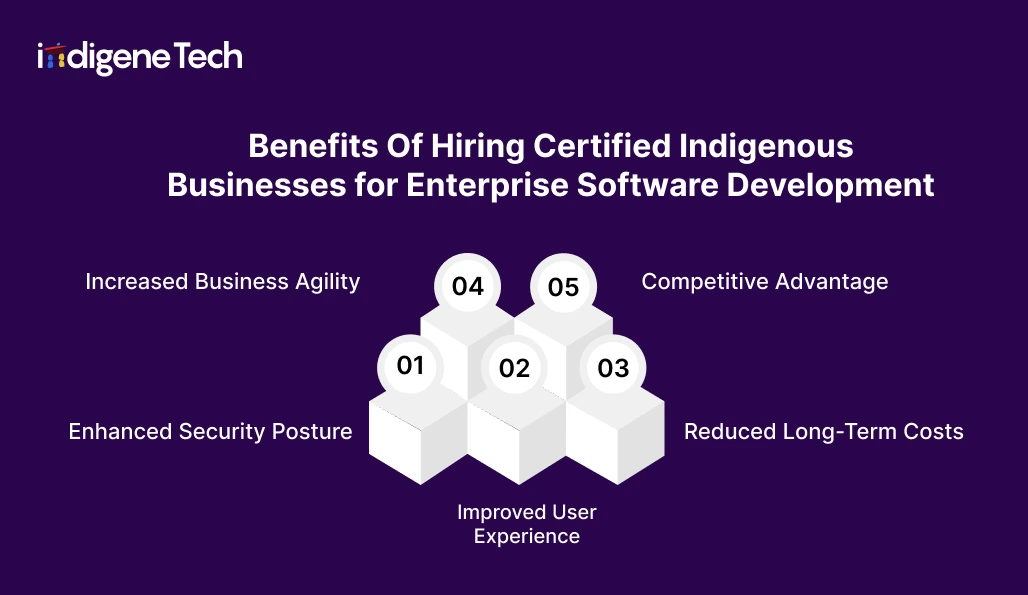
1. Enhanced Security Posture
Security-by-design reduces common risks like weak access control, data leaks, and unsafe integrations. In Custom enterprise software development, strong logging and testing also make it easier to detect issues early. That means fewer major incidents and less damage when something goes wrong.
2. Improved User Experience
Users do not care about architecture. They care about speed and reliability. In enterprise custom software development, scalable patterns reduce slow screens, timeouts, and “try again later” errors. The experience stays steady even when traffic spikes.
3. Reduced Long-Term Costs
Teams often chase the cheapest build. Then they pay for it later in fixes and rewrites. In Custom enterprise application development, scalable design and clean DevOps reduce rework. Monitoring reduces debugging time. Good security reduces expensive incident handling. Over time, the total cost drops.
4. Increased Business Agility
When the system is modular and well-tested, changes are easier. In Custom enterprise app development, you can add a feature, integrate a new tool, or launch a new region without breaking core workflows. This gives the business room to move faster.
5. Competitive Advantage
Many enterprise buyers ask tough questions now. How do you protect data? How do you handle incidents? What is your recovery plan? A Certified Indigenous team that can show these answers clearly earns trust faster. A team that can prove compliance readiness also reduces buyer hesitation.
2026 Trends Shaping Enterprise Software Development
Trends come and go. But in Enterprise Software Development, 2026 is pushing teams toward one clear direction. Build systems that are secure by default, easier to scale, and easier to operate. A Certified Indigenous team usually treats trends like tools, not like trophies. Many teams do the same. They ask, “Will this reduce risk and support load?” before they adopt it in enterprise custom software development.
Here are the trends that matter, with a practical lens.
1. Cloud-Native And Hybrid
Cloud-native is not only “move to cloud.” It means containers, managed services, and scaling rules that are designed for real traffic. Hybrid is growing too, because some enterprises keep parts on-prem for policy or legacy reasons. In Enterprise Software Development, the winning approach is clarity. Which workloads stay where, and why? A Certified Indigenous team documents this early, so deployment does not turn into confusion later.
2. Containerization And Serverless
Containers help standardize environments, so “works on my machine” disappears. Serverless is useful for event-driven tasks like file processing, notifications, and short background jobs. In enterprise custom software development, the rule is simple. Use containers for core services. Use serverless for bursty tasks that are easy to isolate. A Certified Aboriginal Business team will also watch cold starts, cost spikes, and security boundaries.
3. Security Automation And SOAR
Security teams cannot chase everything manually anymore. In Enterprise-grade custom software development, automation helps with vulnerability scanning, secrets detection, access reviews, and alert triage. SOAR is useful when you have repeated incident patterns, like suspicious logins or API abuse. A Certified Indigenous team will still keep humans in the loop for high-risk actions, because automation without review can create its own problems.
4. API Security Is Getting Stricter
APIs are the backbone of enterprise systems. In Custom software development for enterprise organizations, API security is moving beyond simple authentication. Rate limiting, anomaly detection, token rotation, and audit logging are becoming baseline. A Certified Aboriginal Business team will also push for clear API versioning, because breaking changes create downtime and angry customers.
5. AI Integration, But With Guardrails
AI features are being added into search, support, reporting, and document processing. In enterprise custom software development, the smart move is guardrails. Human review for critical actions. Clear logs of prompts and outputs. Data privacy controls. And safe fallbacks when the model fails. A Certified Indigenous team will also define what AI is allowed to do, and what it must never do.
6. Low-Code And No-Code
Low-code tools can speed up internal workflows, dashboards, and simple approval flows. But they can also create vendor lock-in and messy governance. In Custom software development for enterprise organizations, use low-code where the risk is low, and keep core logic in controlled codebases. A Certified Aboriginal Business team will usually insist on this separation for compliance and long-term ownership.
How To Choose A Certified Indigenous Business Partner For Enterprise Software Development
Choosing a partner for Enterprise Software Development is not like hiring for a brochure website. The stakes are higher. Your data, uptime, and daily operations sit inside the system. A Certified Indigenous partner can be a strong choice, but only if their delivery approach matches enterprise needs. The same applies when you are evaluating a Certified Aboriginal Business team for enterprise custom software development.
Here is what to look for, in a practical way.
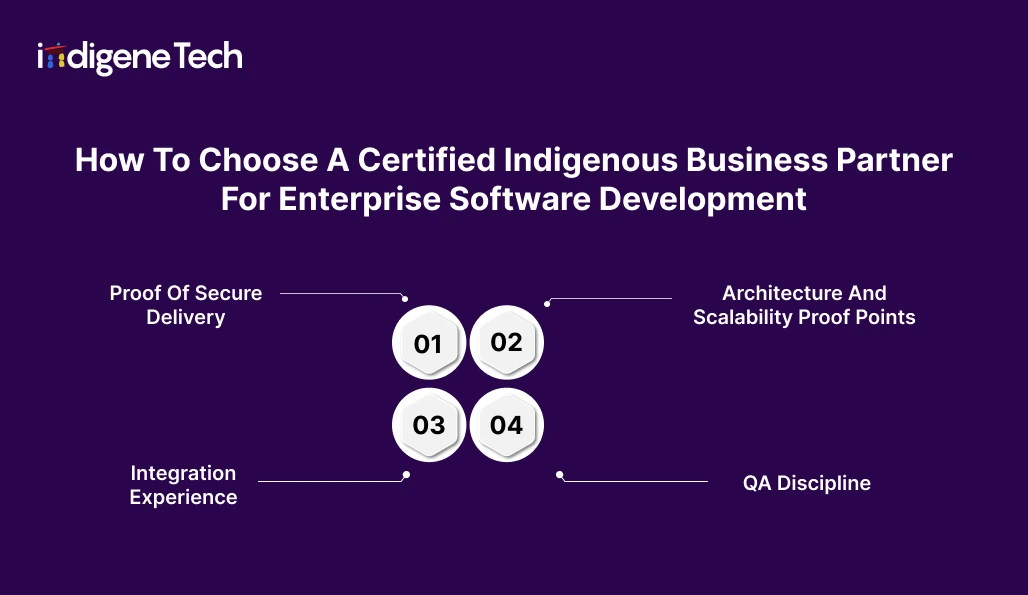
1. Proof Of Secure Delivery
Ask how they handle security from day one. In Enterprise Software Development, the right team can explain access control, encryption, logging, and testing without sounding vague. They should show how security checks run inside CI/CD, and how they handle vulnerabilities and patches in enterprise custom software development.
2. Architecture And Scalability Proof Points
Ask for examples where they scaled a platform, not only built it. In enterprise custom software development, good teams can explain their scaling choices. Why modular design? Where they used caching. How they handled load balancing. What they monitored. An Indigenous-owned enterprise team should also be able to show how they plan resilience and recovery.
3. Integration Experience
Enterprise systems connect to many tools. ERP, CRM, identity providers, analytics, and payment processors. In Custom software development for enterprise organizations, integration failures are common and costly. Ask how they design retries, error handling, queues, and versioning for integrations. Ask how they monitor integrations in enterprise custom software development.
4. QA Discipline
Ask what they test and how. In enterprise custom software development, testing should include automated unit tests, API tests, and regression suites for core workflows. Ask how they run performance tests and security tests. A Certified Aboriginal Business team should also be comfortable with audit-friendly documentation for testing evidence.
Also read: A Complete Guide to Indigenous Owned and Operated Businesses in 2026
Final Thoughts
Enterprise platforms do not fail because teams are lazy. They fail because scale and security were treated like “phase two.” In Enterprise Software Development, phase two arrives fast. More users. More data. More integrations. More risk. That is why Certified Indigenous Business teams that build with security-by-design and scalability patterns from day one often deliver calmer, more stable systems.
If you are comparing partners, look beyond the demo. Ask about testing depth, DevOps discipline, monitoring setup, and incident readiness. These are not “extra services.” They are the foundation of enterprise custom software development that survives real operations. The same evaluation applies when you speak with a Certified Aboriginal Business team. The best teams can explain their process clearly, show proof, and own what happens after launch.
A simple rule to remember. If a team cannot explain how they scale, secure, and monitor the system, they are not ready for Custom software development for enterprise organizations. The strongest teams make these parts boring. And boring is good when money and operations depend on the system.
FAQs
1. What Does Certified Indigenous Business Mean In Enterprise Software Development?
An Indigenous-owned business is typically a verified Indigenous-owned company. In Enterprise Software Development, this matters because many buyers want trusted suppliers with clear governance and accountability. But certification alone is not enough. You should still check their security process, testing depth, and support model for enterprise custom software development.
2. What Makes Enterprise Software Development Different From Normal App Development?
Enterprise Software Development deals with complex workflows, roles, approvals, integrations, and compliance needs. The system must stay stable under load and be easy to maintain for years. In enterprise custom software development, that means stronger architecture, deeper testing, and better monitoring than a typical consumer app.
3. What Are The Must-Have Security Controls In Enterprise Software Development?
In Enterprise Software Development, the basics include role-based access control, encryption, secure coding, audit logs, vulnerability scanning, and regular security testing. An Indigenous-owned company team should also define patch management and incident response clearly. These controls reduce real risk in enterprise custom software development.
4. How Do You Make Enterprise Custom Software Development Scalable Without Overspending?
Start with modular design, stateless services where possible, database optimization, caching, and async processing. In enterprise custom software development, avoid over-building microservices too early. A Certified Aboriginal Business or Certified Indigenous Business team should justify scaling choices using expected load, growth plans, and cost limits.
5. What Questions Should I Ask Before Hiring A Certified Indigenous Business For Enterprise Software Development?
Ask how they handle security-by-design, automated testing, CI/CD, rollback strategy, monitoring setup, and post-launch support. In Enterprise Software Development, the right team will answer with clear steps and real examples. This applies equally when evaluating a Certified Aboriginal Business partner for enterprise custom software development.