
In Canada, Indigenous communities including First Nations, Inuit and Métis people, face both challenges and opportunities in this time with rapid digital changes. Problems such as geographical remoteness, limited infrastructure, cultural margins and digital division are important. Nevertheless, digital tools and technologies show more powerful ambassadors: they increase economic opportunities and strengthen cultural protection and promote society's self-determination. At IndigeneTech, our mission is to help indigenous communities to reach, adopt and adapt in ways that respect their cultures, support their ambitions and create a sustainable future.
This blog explores what digital tools are, how they are being used by Indigenous entrepreneurs and communities in Canada, real-world models, and what actions can help maximize their benefits.
Understanding the Context
Before discussing digital tools, it’s important to understand the landscape:
- Geographic & infrastructural constraints: Many Indigenous communities are in rural or remote areas, where access to high-speed Internet and modern digital infrastructure is limited. These communication barriers, education, access to markets, and many online services.
- Cultural and language preservation: Indigenous communities in Canada have rich traditions, languages, and knowledge systems. Many of these are threatened through previous colonial policies, assimilation, and allowing for younger generations to become disconnected from the elders.
- Economic opportunity & gaps: Indigenous economies are growing. Indigenous businesses are contributing tens of billions of dollars to the GDP of Canada each year, yet many entrepreneurs can be limited in their ability to grow by many barriers, such as lack of capital, business support, scale, and limited access to training in digital skills.
- Desire for self-determination and cultural integrity: Indigenous peoples are involved in a strong and ongoing movement towards self-development and control of their own economic, educational and social development; Cultural and language preservation and promotion; And this insurance that no future technology coordinates optimization and supports through the use of local values, knowledge and social preferences.
Given that context, digital equipment is not a universal remedy, but when they are thoughtfully deployed, they can help bridge intervals, open new opportunities,and support indigenous entrepreneurship, innovation and flexibility.
Types of Digital Tools & How They Empower
Below are categories of digital tools, with specific examples and how they empower people in Indigenous communities and entrepreneurs.
| Tool / Technology | How it Empowers | Examples in Canada / Best Practice |
| Connectivity & Reliable Internet / Broadband | Without reliable access to the internet, many digital tools are useless. Broadband access enables online education, remote work, e-commerce, telehealth, digital communications, cultural sharing. | Canada has initiatives like Connectivity in Indigenous Communities that aim to bring high-speed internet to remote and First Nations areas. IndigeneTech can support or leverage such infrastructure projects. |
| Digital Skills & Training Platforms | Training in digital literacy (basic computer skills, internet safety), more advanced skills (coding, data management, digital marketing), and life-skills like financial management, project management, etc., empower individuals to participate fully in the digital economy. | "Empower indigenous peoples through digital skills" projects (by NWAC, OAS, Microsoft, Trust for the United States) to enable indigenous women, girls, two-spirit, transgender people, and gender-class individuals to enable digital literacy, project management, life skills, and technology/economics to participate in the economy. |
| Entrepreneurship Training, Mentorship & Innovation Support | Offering guidance, mentorship, business development tools, models, and networks helps entrepreneurs turn ideas into viable businesses. This includes training in how to build a business, get financing, scale operations. | Indigenous Entrepreneurship Training Empowered Nations offers fully virtual curriculum tailored for Indigenous entrepreneurs. Also, Indigenous Innovation Initiative supports innovative, scalable, community-led ideas. |
| E-Commerce & Digital Marketing Tools | These tools allow entrepreneurs to reach customers beyond local communities, sell products online, tell their stories, promote culture, build brand identity, and increase revenues. | CCAB’s program “Tools and Financing for Aboriginal Business” helps Indigenous businesses adopt e-commerce, digital marketing, payments online. For example, Indigenous businesses are selling online at higher rates than many non-Indigenous businesses in Canada. Social media initiatives like We Create by Meta help Indigenous-owned businesses build digital-first campaigns. |
| Community & Cultural Preservation Platforms | Digital tools can help document, preserve, and teach Indigenous languages, stories, history, arts; ensure cultural content is owned by communities; support intergenerational transfer. | FirstVoices: an online platform where Indigenous communities document, share, and teach their languages (audio recordings, texts, dictionaries, etc.). Ownership of content is with the community. Also tools like language keyboard apps, digital archives, etc. |
| Project Management, Operations & Business Tools | To run a business or project successfully one needs tools to manage operations, finances, collaboration, logistics. Digital tools (ERP, POS systems, workflow/project management, accounting software) help with efficiency, accuracy, scaling, reducing manual load. | Many indigenous contractors use cloud-based ERP Solutions to handle sales, inventory, customer relationship. Project management equipment such as trailo, asanas, slacks, etc. helps coordinate teams in remote areas. (While I didn’t find a specific named Indigenous case in our sources for Trello etc., this is commonly adopted.) |
| Apps & Platforms for Peer & Network Collaboration | Tools that enable peer-to-peer learning, mentorship, networking (virtual or hybrid) assist entrepreneurs to share experience, access resources, find partners, and tap into broader ecosystems. | “Taking IT Digital” project: developed an app to support Indigenous entrepreneurs and social innovators, offering applied learning, strategy tools, coaching, mentorship, especially for those in remote Northern communities. |
| Funding & Finance Platforms / Digital Grants | Tools and programs for accessing grants, loans, micro-financing, financial management, digital payment systems enable entrepreneurs to operate, grow, scale. Digitization of financial services helps reduce barriers of distance, paperwork, time. | CCAB’s work includes micro-grants (e.g. to adopt e-commerce) and digital financing. Indigenous Prosperity Foundation report notes that digital barriers, like lack of tools, limit potential, so improving financial tools and access is crucial. |
Real-World Examples & Case Studies
To make the above more concrete, here are several examples of how Indigenous communities and entrepreneurs are already using digital tools in Canada:
- Empowering Indigenous Peoples through Digital Skills :This project (run by NWAC, OAS, The Trust for the Americas, Microsoft Philanthropies) focused on providing culturally sensitive digital and life-skills training. Over 2023-2024, it trained hundreds of individuals in Indigenous communities, including facilitators who can transfer skills locally. The project aimed not only to build individual capacity but to foster economic inclusion and resilience in Indigenous communities.
- Tools and Financing for Aboriginal Business (TFAB) via CCAB :Through TFAB, Indigenous businesses can get expertise, mentoring, and micro-grants to adopt e-commerce, digital tools, improve operations, marketing etc. CCAB has found that Indigenous businesses are early adopters of new tech (e-commerce, online payments), often at higher rates than many non-Indigenous businesses.
- FirstVoices : A long-standing program for language revitalization communities build their own language resources, dictionaries, archives, teaching tools; apps for language, keyboard tools, etc. This preserves cultural heritage and ensures that future generations can access and learn Indigenous languages.
- Taking IT Digital (EntrepreNorth project) : Developed an app and virtual learning tools specifically for Northern and Indigenous entrepreneurs, helping them build business strategies, connect with mentors and coaches, and share resources, even when physically remote. The design incorporates Indigenous perspectives, values and supports.
- Indigenous Innovation Initiative (I3): Support indigenous leadership innovations, including ideas that deal with health, social and economic challenges in local communities. Culturally relevant solutions, social control, emphasis on permanent effects. Provides financing and capacity building.
The Benefits: What Empowerment Looks Like
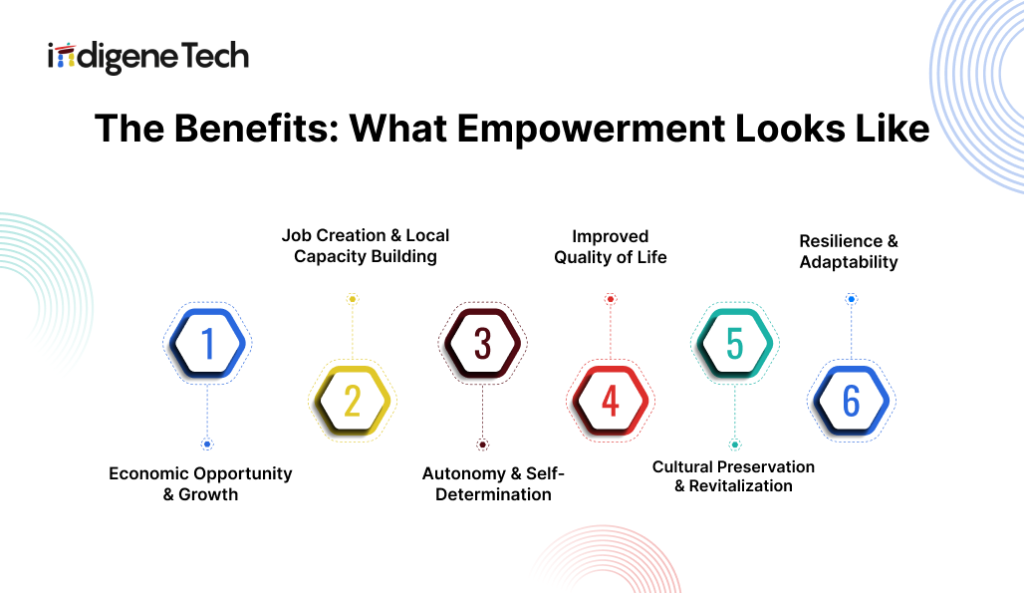
When digital tools are adopted well, they can lead to a range of transformative benefits:
- Economic Opportunity & Growth: Entrepreneurs can use wide markets (national and international) to create new income streams through e-commerce, can reduce costs through efficiency, can benefit from online payment systems and be limited to local customers.
- Job Creation & Local Capacity Building: Digital tools not only enable new jobs in companies that sell goods directly but also in technical assistance, digital material construction, marketing, cultural archive work, translation, app development, etc.; training also creates skills that make community members more employed or able to run their own initiatives.
- Autonomy & Self-Determination: Instead of relying on external systems and institutions, society can use digital units to document its culture, manage its own data and projects, preserve languages, tell their stories and determine the values.
- Improved Quality of Life: Better connection improves access to health services (telehealth), education (online courses, distance education), state services, and information. Digital communication helps to reduce isolation, especially in remote societies.
- Cultural Preservation & Revitalization: The equipment for learning languages, digital archives and storytelling platforms makes it possible to preserve culture and knowledge in available, attractive formats; The material can be produced by community members, who ensure authenticity and control.
- Resilience & Adaptability: During times of crisis, natural disasters, pandemics, economic disruptions—communities with good digital infrastructure and skills can adapt more readily: remote work, remote schooling, and digital commerce can help buffer some of the impacts.
Challenges & Considerations
It’s critical, however, not to see digital tools as a silver bullet. Their effectiveness depends on addressing several challenges:
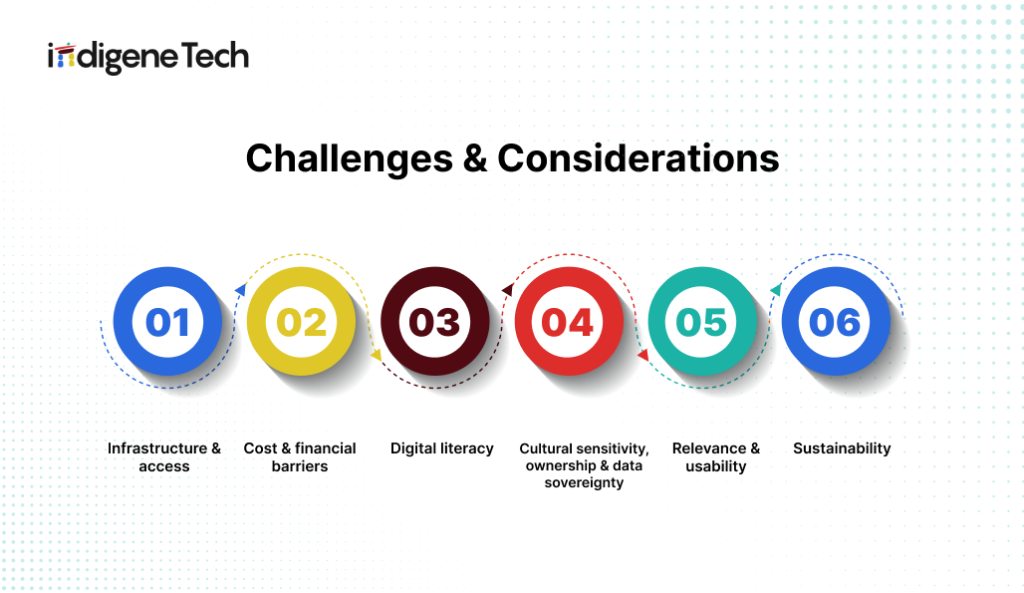
- Infrastructure & access: As mentioned, lack of broadband, unreliable or expensive Internet, limited access to devices, electricity or power can hinder digital adoption.
- Cost & financial barriers: Even when tools are available, cost of hardware/software, subscription fees, maintenance can be prohibitive.
- Digital literacy: Knowing how to use tools safely, efficiently, and effectively is essential. Training must be accessible, culturally relevant, and ongoing.
- Cultural sensitivity, ownership & data sovereignty: It matters who controls the technology, owns the data, sets the priorities. Indigenous communities must retain control over their cultural content, language resources, stories. Tools should be designed with respect for local knowledge, traditions, values.
- Relevance & usability: Tools must be adapted to local contexts: often remote, possibly with multiple languages, low bandwidth, limited tech support. Interfaces, content, designs must be appropriate.
- Sustainability: Projects must plan for long-term maintenance: funding, community capacity to maintain tools, updating, upgrades.
What Best Practices Enable Success
Drawing on the examples above, as well as what we at IndigeneTech see, here are practices that help ensure digital tools empower, rather than fail to deliver.
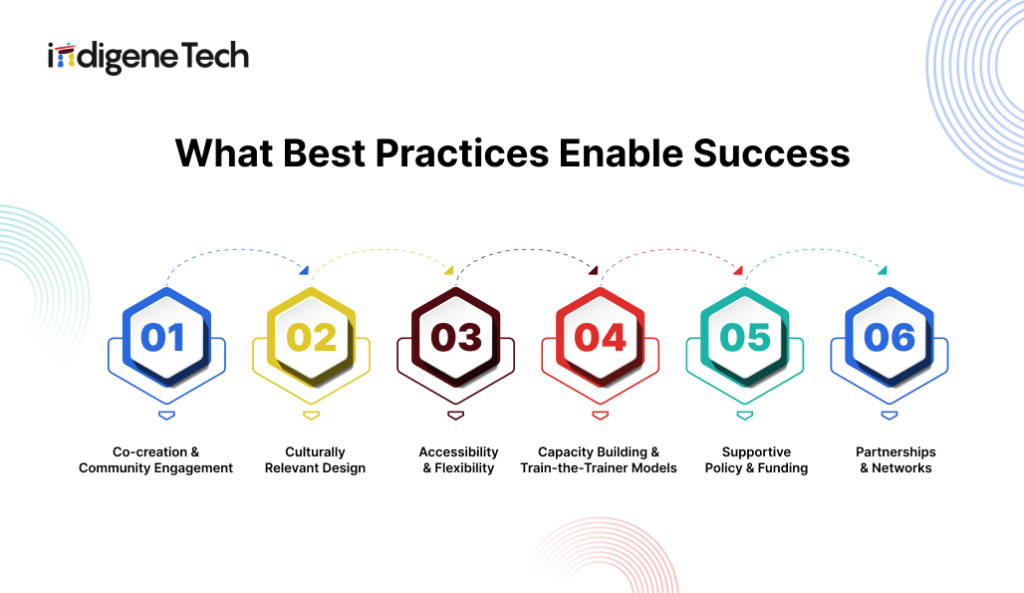
- Co-creation & Community Engagement: Involve community members, elders, knowledge keepers, youth in design and implementation. Understand needs, values, culture. Projects like FirstVoices and Taking IT Digital show how involving communities at every stage improves relevance and buy-in.
- Culturally Relevant Design: Tools should reflect local languages, cultural protocols, values. Learning materials, interfaces, content should feel authentic, not one-size-fits-all. Data sovereignty (that community owns/controls their data) is central.
- Accessibility & Flexibility: Training should be available in person and online; tools should work in low bandwidth settings; content should accommodate different languages; sometimes offline functionality is needed.
- Capacity Building & Train-the-Trainer Models: It’s not enough to train individuals; building local trainers, knowledge holders, technical support ensures skills can be passed on, tools maintained, and community self-sufficiency increases.
- Supportive Policy & Funding: Programs designed to reduce the cost of using supplements, microfinance, digital tools; Guidelines that ensure similar access to broadband; Money for long -term maintenance.
- Partnerships & Networks: Financies can get the scope of support, authorities, non -governmental organizations, technical companies in the private sector, resources, scale. Mentership Networks helps entrepreneurs and shares best practices..
Recommendations: How IndigeneTech Can Lead & Support
Given our mission at IndigeneTech, here are some strategic directions and recommendations to maximize the power of digital tools for Indigenous communities and entrepreneurs.
- Assess community needs & infrastructure readiness: For each community: evaluate current internet access, device availability, energy/power situation, digital skills baseline, preferred languages & culture. Use this assessment to choose tools that match realities.
- Provide modular, cultural-root training programmes: Create training packages that cover digital reading skills, business skills, digital marketing, etc., but they are tailor-made with indigenous peoples' approaches, traditional knowledge and flexible distribution (e.g., distal, small groups, mixed). Think of the model that strengthens indigenous peoples through digital skills.
- Develop or source tools that prioritise data sovereignty & local ownership: Whether the language app, archives or market platforms, make sure that ownership of social material maintains how it is shared; it controls it. Provide training and equipment that enables them to maintain, update and encourage their digital assets.
- Promote e-commerce and digital marketing with storytelling: Help entrepreneurs build online stores and use social media, digital ads, SEO, and email marketing. Emphasise that those tools are not just transactional but storytelling tools: telling the story behind the business, culture, and artisanship.
- Support local tech ecosystems & peer networks: Encourage mentorship and collaboration among Indigenous entrepreneurs (sharing tools and experiences), possibly co-working or tech hubs in Indigenous communities. Support Northern/regional entrepreneurs who may otherwise be isolated.
- Ensure funding & financial tools are accessible: Assist with identifying and applying for grants, micro-funding, loans; provide guidance on financial planning, accounting systems, digital banking/ payments. Ensure tools/services are low-cost or subsidized where possible.
- Maintain sustainable infrastructure & devices: Help with procurement of appropriate hardware (durable, energy efficient), with planning for maintenance, upgrades. Where possible, use cloud solutions and lightweight tools that reduce local device and support burdens.
- Monitor, evaluate, and iterate: Implement feedback loops: what’s working, what isn’t; adjust tools/training accordingly. Collect metrics: how many users trained, how many businesses started, revenue changes, cultural preservation outcomes, etc.
Forward Looking: Emerging & Future Tools
There are several technological trends and tools that hold strong promise for Indigenous entrepreneurship and communities:
- Augmented Reality (AR), Virtual Reality (VR), Immersive Storytelling: These can be used for cultural tourism, teaching, heritage site storytelling, language immersion, virtual museum experiences.
- Mobile & Offline-First Apps: Given that connectivity can be intermittent, apps that work offline or sync when connected are crucial.
- Blockchain & Digital Identity Tools: For verifying authenticity of Indigenous artworks/traditional crafts, ensuring fair compensation, tracing provenance.
- Open Source Tools & Platforms: Lower cost, more flexible, community-customizable.
- AI & Machine Learning for Language Revitalization: Automated transcription of audio recordings, speech-to-text tools in Indigenous languages, translation, etc., though with caution about cultural sensitivity and ownership.
- Fintech Innovations: Peer-to-peer payment platforms, mobile banking, micro-insurance etc., to reduce friction in financial access.
Conclusion
Digital tools when thoughtfully chosen, adapted, and implemented offer powerful pathways for empowerment in Indigenous communities across Canada. They can help preserve culture, strengthen languages, support entrepreneurial activity, improve quality of life, and enable self-determination. At IndigeneTech, we believe in working with communities, respecting values, supporting ownership, and giving tools that match real needs.
If your community or business is considering how to incorporate digital tools whether improving connectivity, launching an online store, building cultural archives, or gaining digital skills reach out. We can help map your needs, suggest tools, provide training, and partner to build something sustainable together.